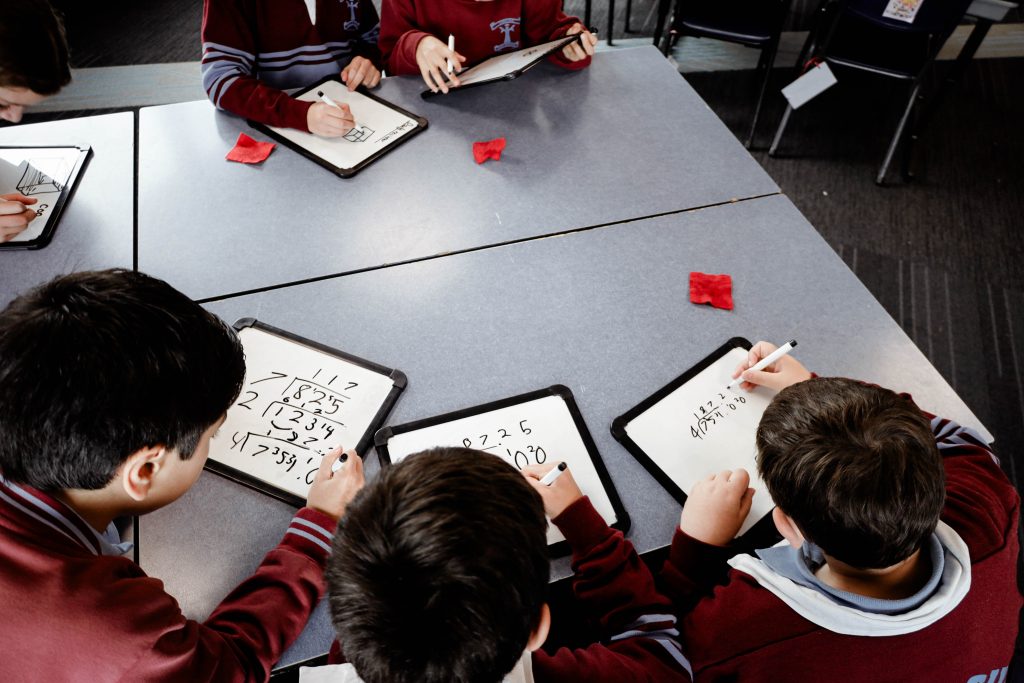
Mathematics at Christ Our Holy Redeemer is implemented in line with the Victorian Curriculum 2.0 and provides our students with essential mathematical knowledge in Number and Algebra, Measurement and Geometry, Statistics and Probability.
Our Approach to Teaching Mathematics
We use a clear, structured approach to help every child build strong mathematics skills and confidence over time. Our program is based on research about how children learn best and is designed to support all learners. Drawing on cognitive science, we know students learn best when new ideas are clearly explained, practised and regularly reviewed. We use an explicit teaching approach where teachers model new learning, guide practice and support students to work independently.
WHAT THIS LOOKS LIKE IN THE CLASSROOM:
Step-by-step teaching
New concepts are clearly explained before students try them independently.
Example: Using blocks or drawings to solve 23 + 15.
Thinking modelled by the teacher
Teachers model their thinking so students can see how to solve problems.
Example: “First I add the tens, then the ones…”
Guided to independent practice
Students practise with support, then gradually try problems on their own.
Example: Solving a few subtraction problems as a class before completing similar ones independently.
Skills build over time
Learning is carefully sequenced from simple to more complex ideas.
Example: Students might first learn to recognise shapes, then describe their features (eg. sides and corners) and later use that knowledge to solve problems involving area or angles.
Daily review and revision
Students regularly revisit prior learning to strengthen memory.
Example: Students might begin the lesson with a quick practice of previous learning.
WHAT WE FOCUS ON IN MATHEMATICS:
Understanding numbers (not just memorising)
Students learn what numbers mean using objects, drawings and real-life examples.
Example: Using counters to represent numbers.
Fluency with basic facts
Students develop speed and accuracy with basic facts
Example: Regular practice of number facts and times tables.
Explaining thinking
Students talk about how they solve problems.
Example: “I know 8 + 7 = 15 because I made a 10 first.”
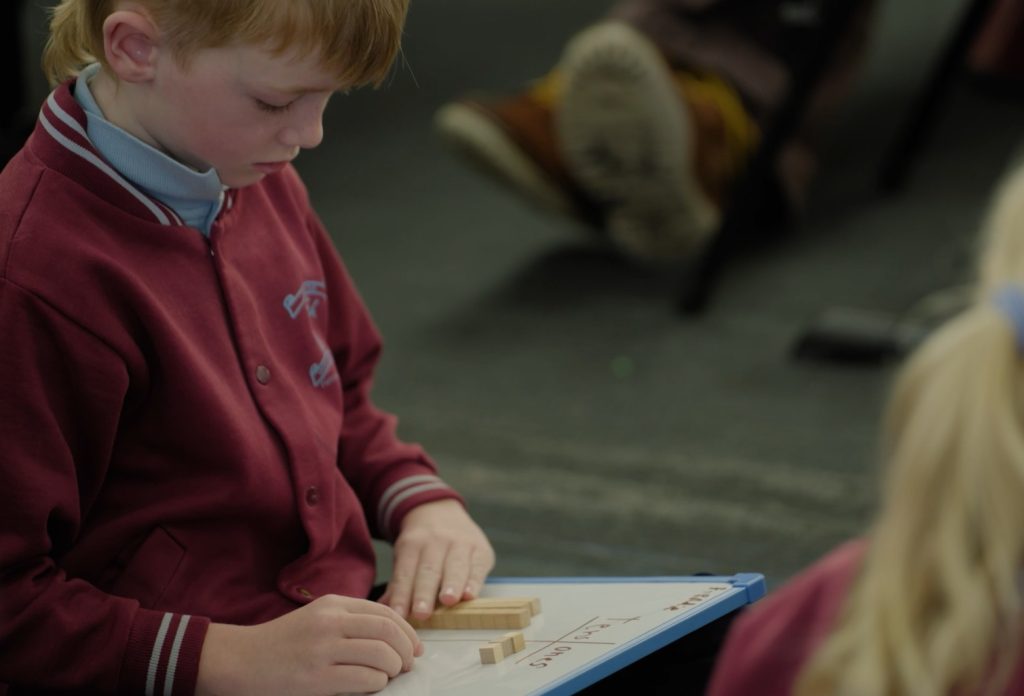
Hands on learning
Concrete materials support understanding before moving to drawings and numbers.
Example: Using counters, blocks or fraction pieces to explore addition or parts of a whole before solving problems on paper.
Problem solving
Students learn how to read, understand and solve real-world problems.
Example: “If you have $10 and spend $6, how much is left?”
Using the right maths language
Students use correct terms to describe their thinking.
Example: Words like “total,” “difference,” “equal” and “groups of.”
HOW WE SUPPORT EVERY LEARNER:
- Teachers check understanding regularly and adjust lessons as needed
- Students receive support when needed and extra challenges when ready
- Practice and review help strengthen memory and confidence
WHY THIS APPROACH WORKS:
By combining clear teaching, guided practice and real understanding, students:
- Build strong foundations in maths
- Gain confidence in solving problems
- Develop skills that support future learning